



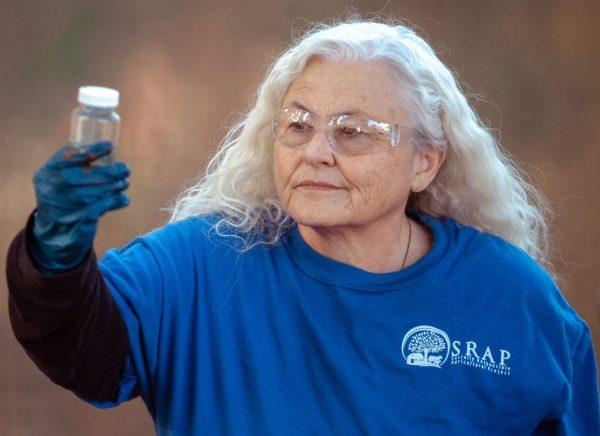


I have lived and farmed in Lenawee County for 46 years, on land that has been in my husband’s family for five generations. We love rural life — the farm, our garden, the pond and trails through the woods on our property, and spending as much time outside as possible. And as farmers, we try to follow the golden rule — do unto others as you would have them do unto you.

Over time, our area has been overrun by an industry that does not follow this rule. There are now 12 concentrated animal feeding operations (CAFOs) in a 10-mile radius of our farm. A CAFO is not your average pasture-based animal farm. Each of these operations holds hundreds to thousands of animals in confinement. Looking at our neighborhood from an aerial view, you can see that we’re surrounded by about 60 manure pits, where the operations store a mixture of urine, feces, and other waste, as well as land application sites, where they dispose of the waste on fields.
These industrial operations spew hydrogen sulfide, ammonia, methane, and more pollutants into our air and water, harming our health, killing wildlife, and keeping us from enjoying the rural way of life. My mother-in-law and father-in-law lived in the house where we live now when the CAFOs first came to this area. They developed concerning symptoms of hydrogen sulfide poisoning — short-term memory loss, anger, headaches, sore throats, and nausea — which would come and go depending on whether the CAFOs were spreading waste nearby.
Now, my husband and I suffer from some of the same symptoms. The toxic emissions often drive us indoors, preventing us from tending to the garden, hanging laundry and working on equipment. We have watched our treasured waterways die. The small fish that once lived in the nearby ditches are gone, replaced by bloodworms.
Manure management is a major source of methane emissions from CAFOs. Increasingly, CAFOs are installing anaerobic digester systems to capture some of the methane and convert it to biogas. Digesters are often proposed as an environmentally friendly way to manage and repurpose manure for energy. In reality, digesters are not the climate solution they’re often heralded as, yet the federal and state governments are pouring public money into them.
Installing a digester allows the operator to participate in lucrative carbon credit markets that can make manure more profitable than milk. These profits incentivize operators to expand their herds, so they can generate more manure, to make more biogas. With larger herds come more methane emissions, as well as more water and air pollution in the surrounding community. To make matters worse, the byproduct from the digesters contains more soluble pollutants than raw manure, causing even greater pollution when it is disposed of on the land.
Digesters cost millions to install, and because the price is so steep, operators often rely on public programs to cover the cost. The US Department of Agriculture (USDA) funds digesters through the Rural Energy for America Program (REAP), which is meant to provide grants for renewable energy systems, like solar panels, and energy efficiency improvements, like efficient lighting. Since 2021, USDA has given over $250 million in grants and loan guarantees to digesters through REAP. The Michigan Strategic Fund has also approved hundreds of millions of dollars in tax-exempt bonds for digesters. These handouts bring returns for digester operators, but not for the public that gave the funds.
An example of these issues is playing out near my own home. In 2021, Chevron invested in a digester at SunRyz Dairy in Lenawee County, relying on a $75 million tax-exempt bond approved by the Michigan Strategic Fund. From 2019 to the present, SunRyz Dairy’s herd grew from 2,350 to 3,250 cows. In 2024, the Michigan Department of Environment, Great Lakes, and Energy cited the digester for emitting hydrogen sulfide at levels above the permitted limit during at least seven months. And last year, the Department cited the digester for failing to even monitor its hydrogen sulfide emissions. I expect that more citations will come.
Funding digesters is a losing investment for taxpayers, local communities and the environment. USDA recently acknowledged as much, issuing a 90-day pause on loan guarantees for digesters due to project underperformance and loan delinquencies. We must stop paying for these false solutions.