





But even if the would-be autocrat in the White House does not find a way to disrupt the midterms, the rise of affordability as the dominant public issue is a both blessing and a trap. The intense focus on micro (household) economics neglects a bigger battle Democrats must fight.
It’s dangerous to make too narrow a response to President Donald Trump’s authoritarian threat. Democracy is menaced on two fronts: first the immediate attack on its institutional bedrocks — fair elections, equal justice, constitutional checks and balances — and second by the underlying cause of the civic emergency: a profound crisis in legitimacy arising from a chronic failure of government to deliver on the most pressing problems affecting peoples’ lives and futures.
The long-term failures of the U.S. government to promote and protect a decent life for most people have produced combustible political kindling, exploited by an authoritarian movement and its charismatic leader, to seize power and ignite the most profound crisis in democracy since the darkest days of the Great Depression.
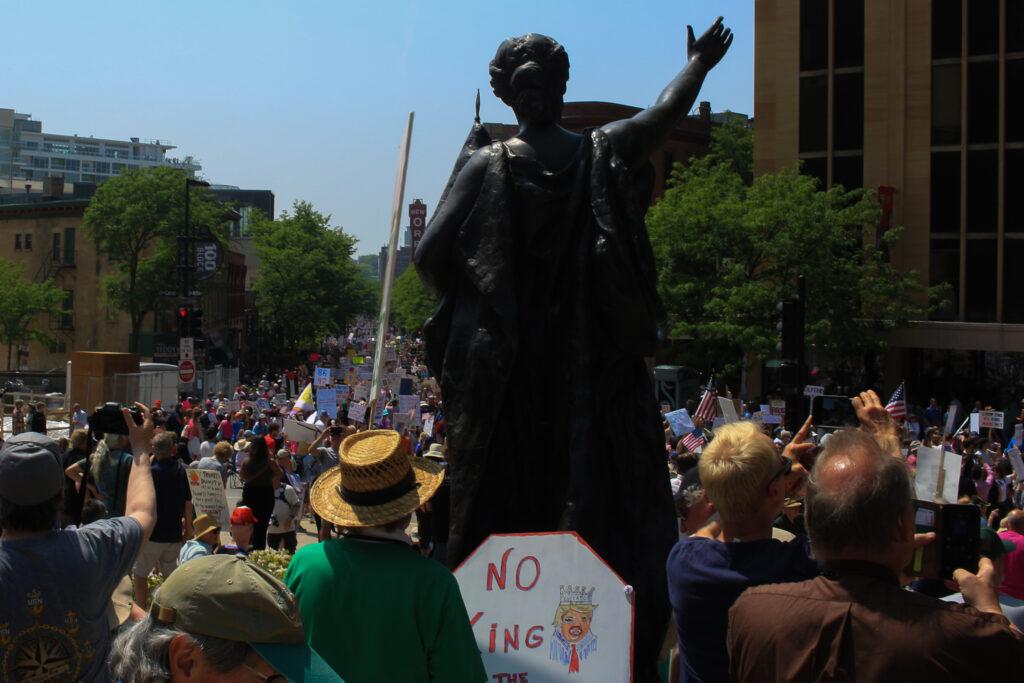
Thousands of our neighbors in Minnesota and Illinois, thrust into the first front of the struggle, are responding with courage and discipline. They are demonstrating the power of organized people and civil society groups with active members, aided by the elected officials they inspire to action, to hold the line for democracy. Grassroots defenders of democracy must continue to peacefully resist every authoritarian offensive, but if we fail to also address the underlying drivers of the crisis, victory will be fleeting.
Wisconsin’s crucial role
As a state that will determine the outcome of the 2028 presidential election, Wisconsin may be fated to play its most important role on the second front: the challenge of demonstrating that democracy is up to the task of meeting the challenges of 21st century life. To meet this charge we must come to terms with the depth of public discontent that has opened millions to the scapegoating rhetoric of authoritarian demagogues while demoralizing and disengaging still more who have come to believe, through embittering experience, they have no stake in democracy.

The affordability crisis is not transitory, it is a symptom of a long-term decoupling of the general economy, and democratic government itself, from the bread-and-butter worries of working people. The widespread realization that the economy is stacked against most people casts a pall over American politics. According to a recent New York Times/Siena poll, two-thirds of respondents believe the middle class is beyond the reach of most Americans.
Until the late 1970s, majorities of voters could believe that a thriving economy would benefit them personally, and that most had a pathway to the middle class. There were glaring inequalities along racial, gender and geographic lines, yet for millions of working class people, including immigrants from around the globe and Black refugees from the Jim Crow South, macro and micro economics were conjoined.
After 50 years of economic rigging orchestrated by the ultra wealthy, the most rapacious corporations, and pliant politicians from both parties, this faith has been dashed. While lacking the suddenness of the 1929 crash, the cumulative effect is like a slow motion slide towards depression for the working and middle classes. In the richest country on Earth a stunning 60% of Americans worry about affording the basics of life, while in Wisconsin 35% of all households, and 60% of Black households, make less than a survival income.
This is no accident. As Harold Meyerson details in The American Prospect, through a half century of deliberate policy choices most of the benefits of growth have been funneled to the privileged few, resulting in a $79 trillion shift in assets to the top. If national income were distributed now as equally as in 1975, each wage earner would make an astounding $28,000 more per year on average. Combined with the deliberate encouragement of massive corporate monopolies with the power to jack up prices, this immiseration is pushing people to a breaking point, making affording health care, housing, energy, food and education more and more challenging for the less than rich.
Despite its effectiveness in abetting the largest wealth transfer in history, government at all levels has been rendered stunningly inept when it comes to public works, social policy, and almost everything else that benefits the working and middle classes.
A parallel crisis in the 1930s
In the New Deal economic order, there seemed to be nothing the government could not accomplish, from the work programs of the 1930s, to the economic mobilization against fascism, Social Security, Medicare, and Medicaid, the Civil Rights and Voting Rights Acts, and the moon mission. Now everything from high speed rail to rural broadband, affordable housing, health care, child care, public education and cheap, renewable energy is tied up in knots.
While much of the blame can be placed on the deliberate sabotage of government by an unholy alliance of grasping billionaires, big corporations, and right wing ideologues, a growing chorus of social critics also point the finger at a major shift in liberalism in the 1960s and 1970s. Recent books by Paul Sabin, Marc Dunkelman, Richard Kahenberg, Yoni Appelbaum, Ezra Klein and Derek Thompson, and to significant degrees Bill McKibben and Gary Gerstle, make parts of a compelling case that the reaction against abuses of administrative power provoked liberals to overcorrect by creating so many regulatory and legal hurdles that government struggles to get anything big done that benefits the working and middle classes.
Further tarnishing public trust, this impotence does not apply to oligarchic power. The only force with the political and economic resources to cut through all the landmines and bottlenecks to bold action are the giant corporate monopolies, as we are seeing with the reckless buildout of highly unpopular AI data centers without guardrails to protect the public interest in affordable energy, clean air, and the stability of the climate on which we all depend.
The most useful historical analogy to our perilous situation is what Franklin Roosevelt confronted after Herbert Hoover’s futility in responding to the calamity brought on by that era’s economic royalists. Jonathan Alter and Eric Rauchway show that top opinion leaders of the era such as Walter Lippmann and William Randolph Hearst believed democracy too paralyzed to succeed, and openly advocated for Roosevelt to suspend Congress and assume dictatorial powers.

Roosevelt was reportedly quite taken with the movie Gabriel Over the White House, a Hearst-funded production about a president seizing dictatorial power and curing the Great Depression. Ultimately, Roosevelt refused to take this path, although he fretted that failure would make him the last president. Democracy’s last near death experience in the 1930s has passed from collective memory only because Roosevelt did not fail.
Drawing on reforms developed over three decades of progressive and labor organizing, Roosevelt amassed sufficient power to take radical action within the constitutional order to restructure and democratize the economy. Despite atrocious racial discrimination baked in by segregationist Democrats, the reforms tangibly improved material circumstances enough to restore the public’s belief that democracy could deliver. Despite receiving only half a loaf, even Black voters defected from the GOP in droves.
A difference between 1933 and 2026 is that authoritarians had not yet seized power, and despite sharp policy disagreements, Hoover and Roosevelt were committed to democratic norms. Today’s political crisis, like the crisis of the 1930s, is driven by economic elites capturing public policy and destroying democracy’s capacity to deliver what people need to thrive.
Divided Democrats
Within the big tent of the current pro-democracy coalition there is a comparable division to that of Roosevelt’s time on the necessity of structural reform. The division is even more dangerous now, in the face of an actual authoritarian takeover. This fissure is exemplified by the vast gulf between two of the most successful “blue wave” candidates of 2025: New York Mayor Zoran Mamdani, and Virginia Governor Abigail Spanberger, who gave the Democratic response to Trump’s State of the Union.

Spanberger’s affordability agenda focuses on the cost of health care, housing, and utilities. Although strongly messaged, substantively she offers a series of opaque technocratic fixes and small bore policies that will not shift pricing power away from monopolies, nor raise the incomes of workers. For example, she nibbles around the edges of health care, yet keeps the foxes in the henhouse, leaving hospital monopolies, big insurance and Big Pharma in control of setting grossly inflated prices.
This contrasts sharply with Mamdani, who offers remarkably clear and understandable solutions — a rent freeze, fast free buses, a $30 minimum wage, free universal child care, paid for with a wealth tax — which would make one of the world’s most expensive cities more affordable for working and middle class New Yorkers. While Mamdani’s agenda is challenging to achieve in a system stacked against bold action, in contrast to Spanberger’s suite of solution-ettes, its clarity means voters can fulfil their democratic role by holding either the mayor or those who block his agenda accountable.
This divide among Democrats does not necessarily map on a left to center axis but on whether the affordability crisis requires small adjustments to an otherwise healthy system or structural reform that democratizes power and tangibly improves material circumstances. Marie Gluesenkamp Perez (D-WA), the co-chair of the centrist Blue Dog Democrats, declares: “You do not save democracy by running around, yelling about saving democracy. You do it by demonstrating that democracy and Democratic values deliver better quality of life for normal people.”
Springing the affordability trap
Donald Trump is feeling the brunt of public outrage for his false sales pitches on affordability. If he actually had a program to lower prices and raise wages he would have built greater support for his authoritarian project. We may not be so fortunate if a more effective autocrat is elected in 2028.
This is why affordability is a trap for Democrats: winning elections on empty promises will only deepen the crisis in democracy, setting the table for future authoritarians. Josh Bivens writes for In These Times that creating a more equal and affordable economy requires a “sharp change” in the “policy path” of the last half century.
The only solution to the ails of democracy is deeper and more robust democracy. As I wrote in the Wisconsin Examiner after Gov. Evers ignored public pressure to fight for a better state budget, the future of multiracial democracy does not depend on elected officials alone. It depends on more people organizing effectively to push them towards compelling and forceful action. Movements make leaders, not the other way around.
We have already seen this happen on the first front of the fight to save democracy. Democratic leadership in Congress is fighting harder and using the power they have to more assertively check Trump’s lawless usurpations only because of immense pressure from organized people and everyday Americans. We must now apply this same pressure to demand that candidates and electeds fight to transform the rigged economy and ossified governing structures stacked against effective action.
Because of Wisconsin’s enormous influence in presidential elections, we have a special obligation to light a fire under Democratic candidates for the Legislature and governor in a crowded primary field. We need more people to push the candidates, and more to join with organizing groups that are working to impel them to fight for bold and impactful reforms that a beleaguered and disillusioned people will feel in their daily lives. How Wisconsin Democrats run in 2026, and especially how they govern in 2027, will have a tremendous influence on how presidential contenders run in 2028, a year that could be democracy’s last best hope.